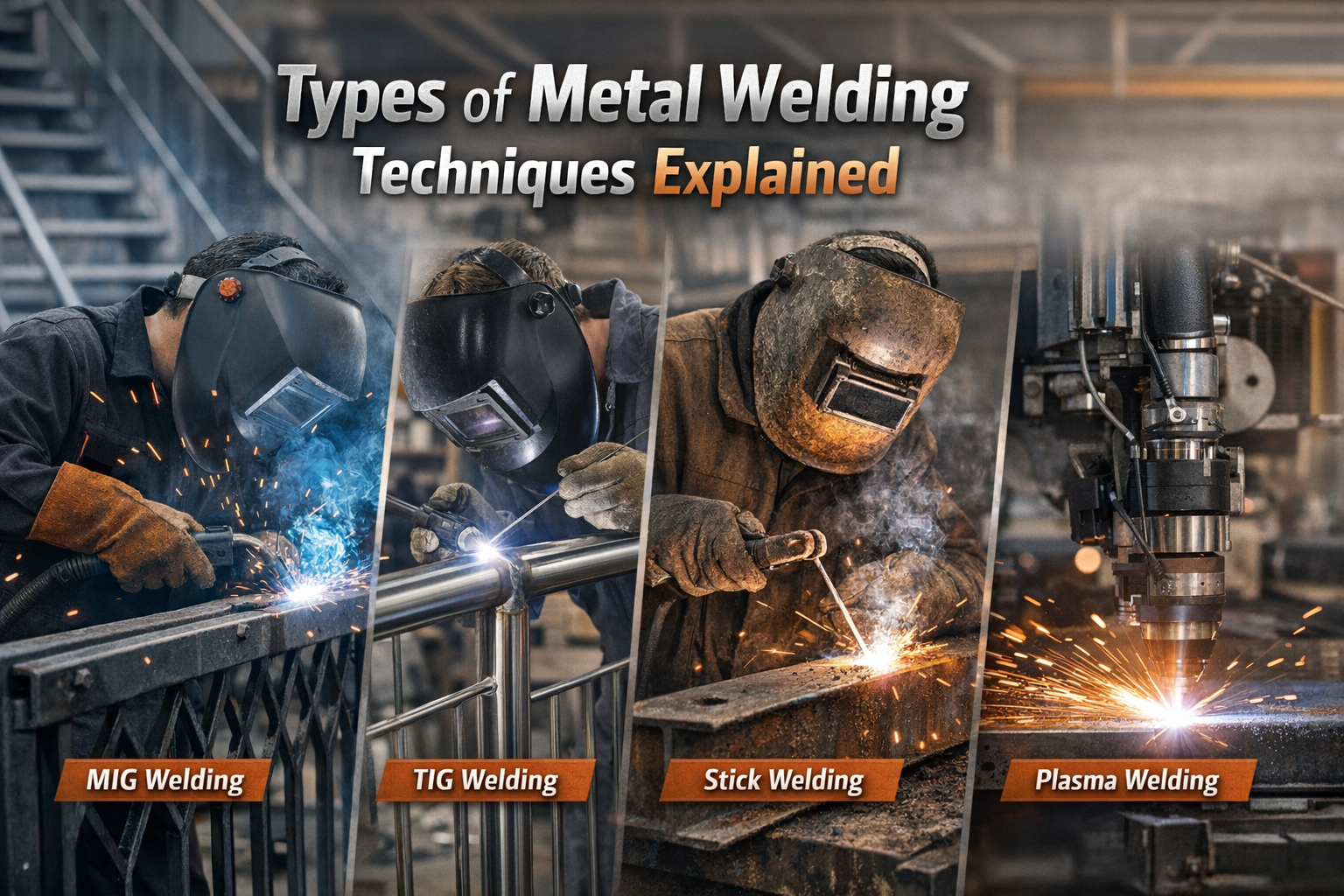
Types of Metal Welding Techniques Explained
Metal welding is one of the most essential techniques used in modern metal fabrication. Whether creating structural frameworks, decorative metalwork, or practical installations such as gates, staircases, balustrades, and fence panels, welding plays a critical role in joining metal components securely. Understanding the different welding techniques helps explain how strong, reliable, and long-lasting metal structures are produced.
In this guide, we explore the most common types of metal welding techniques and how they are used in fabrication and construction projects.
What is Metal Welding?
Metal welding is a fabrication process used to permanently join two or more metal pieces by applying heat, pressure, or a combination of both. During welding, the edges of the metal parts are melted and fused together. In many cases, a filler material is also added to strengthen the joint.
Once the metal cools and solidifies, the welded connection becomes extremely strong, often comparable to the original metal itself. Because of this strength, welding is widely used in industries such as construction, engineering, manufacturing, and metal fabrication.
MIG Welding (Metal Inert Gas)
MIG welding, also known as Gas Metal Arc Welding (GMAW), is one of the most commonly used welding methods in modern fabrication workshops.
This process uses a continuously fed wire electrode that melts to form the weld. At the same time, a shielding gas protects the molten metal from contamination caused by oxygen or moisture in the air.
MIG welding is popular because it is efficient, relatively easy to learn, and capable of producing strong welds across a variety of metals.
Advantages of MIG Welding
- Fast and efficient welding process
- Suitable for mild steel, stainless steel, and aluminium
- Produces consistent welds
- Ideal for thicker materials and structural fabrication
Because of its speed and reliability, MIG welding is widely used in manufacturing and metal fabrication projects.
TIG Welding (Tungsten Inert Gas)
TIG welding, also called Gas Tungsten Arc Welding (GTAW), is known for its precision and high-quality weld appearance.
Instead of a consumable wire electrode, TIG welding uses a tungsten electrode to create the arc that melts the metal. A separate filler rod may be added manually to strengthen the weld. Shielding gas protects the weld area during the process.
This method requires a higher level of skill but produces very clean and controlled welds.
Advantages of TIG Welding
- High precision and control
- Produces smooth and clean welds
- Ideal for thin metals
- Excellent for stainless steel and aluminium work
Because of its accuracy and clean finish, TIG welding is often used in projects where appearance and detail are important.
Stick Welding (Arc Welding)
Stick welding, also known as Shielded Metal Arc Welding (SMAW), is one of the oldest and most widely used welding techniques.
This method uses a coated electrode that melts during welding to form both the weld and a protective gas shield. The coating also creates slag that protects the weld while it cools.
Stick welding is known for its versatility and ability to work in outdoor environments where other welding methods may struggle.
Advantages of Stick Welding
- Works well outdoors and in windy conditions
- Suitable for thicker metals
- Effective for structural steelwork
- Equipment is relatively simple and portable
Because of its durability and flexibility, stick welding is often used in construction and heavy metal fabrication.
Plasma Arc Welding
Plasma arc welding is a more advanced welding technique that uses a highly concentrated plasma arc to join metals. The arc is extremely precise and can reach very high temperatures.
This method is commonly used in specialised manufacturing industries where precision and control are critical.
Advantages of Plasma Arc Welding
- Very precise welding control
- High welding temperatures
- Suitable for automated fabrication processes
- Produces strong and consistent welds
Although it is less common in small fabrication workshops, plasma welding is important in high-precision engineering applications.
Choosing the Right Welding Method
Selecting the appropriate welding technique depends on several factors, including:
- Type of metal being welded
- Thickness of the material
- Required strength of the joint
- Desired visual appearance of the weld
- Working environment (indoor or outdoor)
Each welding method offers different advantages, which is why experienced fabricators often use multiple techniques depending on the project requirements.
Welding in Everyday Metal Structures
Although welding often goes unnoticed, it plays a crucial role in many everyday metal structures. Items such as gates, staircases, railings, balustrades, and fence panels rely on strong welded joints to maintain structural integrity and safety.
Proper welding ensures that these metal structures remain stable, durable, and capable of withstanding regular use and environmental conditions.
The Importance of Skilled Welding
Even with modern equipment and advanced welding technologies, the quality of a welded joint still depends heavily on skill and experience. Skilled welders understand how to control heat, prepare metal surfaces correctly, and create strong welds that meet safety and structural standards.
High-quality welding contributes to the strength, reliability, and long lifespan of metal fabrication projects across many industries.
Welding Standards in the UK
In the United Kingdom, welding work used in construction and metal fabrication must follow recognised industry standards to ensure safety, structural strength, and consistent quality. These standards are widely used by engineers, fabricators, and inspectors across the country.
BS EN ISO 9606 – Welder Qualification
One of the key standards used in the UK is BS EN ISO 9606, which focuses on the qualification of welders. This standard ensures that welders have the necessary skills and knowledge to perform specific welding tasks safely and correctly.
It evaluates a welder’s ability to produce strong and reliable welds under controlled testing conditions.
BS EN 1090 – Structural Steel Fabrication
Another important regulation is BS EN 1090, which applies to structural steel and aluminium components used in construction.
This standard ensures that fabricated metal structures meet strict requirements related to:
- Structural integrity
- Manufacturing control
- Traceability of materials
- Quality inspection
BS EN 1090 is particularly important for metal structures used in buildings, staircases, railings, and other load-bearing applications.
Get a Quote
If you are planning to install an automated gate for your property, our team at East London Metal Engineering Ltd. can help.
We provide professional design, fabrication, and installation services tailored to your requirements.
Contact us today to discuss your project and receive a quotation.
Phone: 079 5167 3924, Telephone: 02039769705, Email: info@eastlondonmetal.com
Factory: Arch 379 Station Road, London, E7 0AB