Once you actually start comparing metal fence panels, the choice narrows fast to three real contenders: palisade, weldmesh, and vertical bar railings. Each does a genuinely different job, and the price gap between them is wide enough that picking the wrong one either overspends on security you don’t need or underspends on security you do. This is a straightforward buying guide what each panel type actually offers, what it costs per metre installed, and how to match the spec to the property rather than guessing.
The Three Main Metal Fence Panel Types
Palisade panels are the vertical pointed-top pale design most associated with industrial and high-security sites warehouses, utility compounds, secure yards. The pales are individually fixed, which makes the fence extremely difficult to climb or breach without cutting tools, and it’s the go-to choice wherever visible deterrence matters as much as the physical barrier itself.
Weldmesh panels use a welded steel grid, either as flat mesh or a stiffer V-mesh profile that resists bending better than flat panels of the same wire gauge. This is the standard choice for schools, parks, and public buildings it’s harder to climb than it looks, offers good sightlines (useful where visibility matters for safety supervision), and comes in a lighter-duty galvanised-only spec or a heavier powder-coated version depending on how much abuse the site sees.
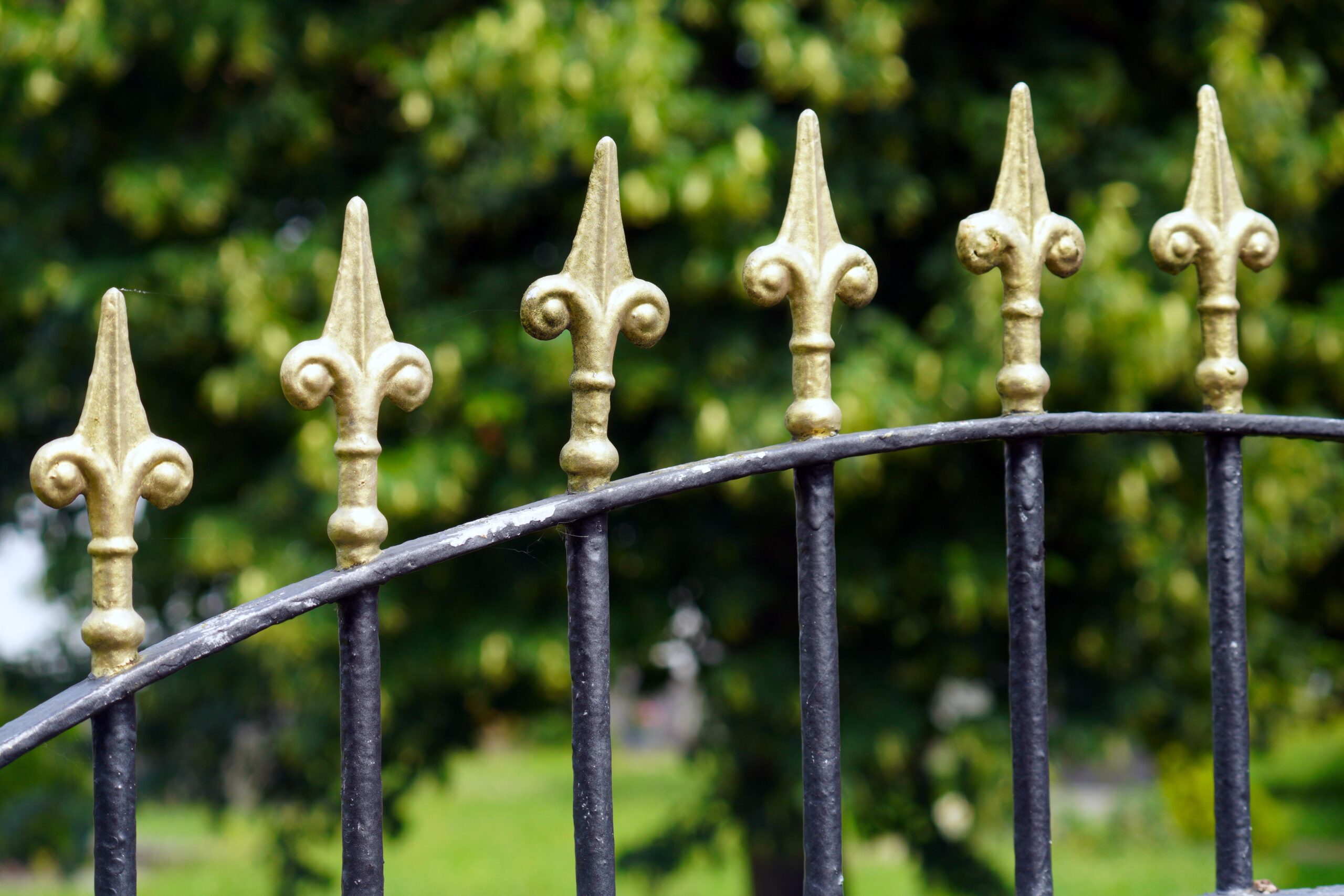
Vertical bar railings are the traditional decorative option evenly spaced steel bars, often with a bow-top or ball-top finish used where appearance matters alongside security. This is the standard spec for residential boundaries, housing developments, and public-facing commercial frontages where a palisade fence would look too industrial.
Standard Heights and What They’re Actually For
Panel heights typically run from 1m up to 3m, and the height you need is really a question of what you’re defending against:
- 1m–1.2m: Decorative boundary marking, residential front gardens, low-security demarcation
- 1.5m–1.8m: Standard residential and light commercial security enough to deter casual intrusion
- 2.0m–2.4m: Commercial and higher-security sites, schools, and public buildings needing a genuine physical barrier
- 3.0m: Industrial and high-security perimeters where climbing resistance is the priority
Worth flagging early: a fence over roughly 2m on a boundary typically triggers planning permission requirements in the UK, and front-facing boundaries have a lower threshold again so the height that suits your security needs and the height you’re allowed to install without planning consent don’t always match, which is worth checking before you commit to a spec.
Matching Panel Type to Property
- Residential boundary, want it to look good as well as function: Vertical bar railings at 1.2m–1.8m give you security without the industrial look.
- School, park, or public building needing sightlines for supervision: Weldmesh panels balance visibility with a genuine physical barrier.
- Warehouse, industrial yard, or utility site: Palisade fencing at 1.8m–2.4m is the standard specification for a reason — it’s the hardest of the three to breach quickly.
- High-risk commercial site needing more than a standard perimeter: Heavier-spec palisade or integrated systems with access control justify the higher per-metre cost.
Why Work With East London Metal Engineering Ltd
At East London Metal Engineering Ltd, metal fence panels palisade, weldmesh, or vertical bar railings are fabricated and installed to match the actual risk and setting of the property, not sold as a single default spec regardless of what the site needs. That means a decorative vertical bar railing for a residential boundary where the fence needs to look right as much as function, or a full palisade system for an industrial site where deterrence and physical resistance come first.
Whether you’re securing a warehouse perimeter, a school boundary, or a residential property across London, the right starting point is matching the panel type and height to what the site actually requires not defaulting to whichever fence looks most secure in a catalogue photo.
Frequently Asked Questions
Which is more secure: palisade or weldmesh fencing?
Palisade generally offers stronger resistance to climbing and cutting due to its individually fixed vertical pales, which is why it’s the standard for industrial and high-security sites. Weldmesh is a solid mid-tier option, particularly where sightlines matter, such as schools and parks.
Do I need planning permission for metal fence panels?
It depends on height and location. Fences over roughly 2m on most boundaries, and lower thresholds for boundaries facing a road, typically require planning permission in the UK — worth checking before finalising your spec.
Why is vertical bar railing pricing so wide-ranging?
Cost scales with bar thickness and height — a 1m railing with 12mm bars costs considerably less than a 2m railing with heavier 20mm bars, so the “vertical bar” category covers a genuinely wide spec range.
What affects installation cost beyond the panels themselves?
Ground conditions are a major factor — posts bolted onto existing concrete install faster and cheaper than posts set into fresh concrete on soft or uneven ground, and site access can add further cost regardless of which panel type you choose.